Most people running an office refurbishment have never done one before. One day you are getting on with your actual job, the next you have been handed responsibility for a project that involves budgets, contractors, your landlord, your colleagues and a building full of decisions you have never had to make. It can feel like a lot.
The good news is that a refurbishment is far more manageable when you break it into stages and work through them in order. That is exactly what this checklist does. It walks you through the whole journey, from working out why you are doing this in the first place, right through to handing everyone the keys to a finished space.
Here is the short version if you only have a minute: a successful office refurbishment comes down to defining why you are doing it, setting a realistic budget and timeline, getting your landlord and stakeholders involved early, choosing the right partner, and planning the works so they cause as little disruption as possible. Everything below expands on those points. No download form, no gated PDF, just the full checklist on one page.
How to use this office refurbishment checklist
This guide is organised by stage, in the order you will actually tackle things. Not every business needs every step, and the scale of your project will dictate how much time you spend on each one. A light cosmetic refresh is a very different beast to a full strip-out and refit.
Work through it from the top. Each stage builds on the one before, and skipping ahead is usually how things get missed. If you want to bookmark anything, jump to the at-a-glance checklist near the end, which condenses everything into a list you can copy or print.
Stage 1: Define why you are refurbishing
Before you think about colours, layouts or furniture, you need to be clear on one thing: why are you doing this at all?
It sounds obvious, but this is the step people rush, and it is the one that causes the most regret later. Your reasons shape every decision that follows, so getting them straight at the start keeps the whole project pointed in the right direction.
Common reasons businesses refurbish include:
- A lease event, such as a break, renewal or expiry, often with the landlord offering to contribute
- Growth, where you need to fit more people into the space you already have
- A shift to hybrid working that your current layout was never designed for
- A space that has become dated, tired and no longer reflects your brand
- Wanting to attract and retain staff in a competitive market
- Improving wellbeing, comfort and the day to day experience of being in the office
- Making better use of space you are paying for but not using well
- Meeting sustainability targets or updated compliance requirements
Once you know the why, turn it into something measurable. “We want a nicer office” is not a goal. “We want to increase meeting room availability and give people somewhere quiet to take calls” is. Clear objectives let you judge every later decision against whether it actually solves the problem you started with.
If you are still weighing up whether a refurbishment is even the right route, our guide on office fit out vs office refurbishment breaks down the difference and helps you work out which one you need.
Stage 2: Assemble your project team
A refurbishment is too big to carry on your own, and too important to design by committee. The answer is a small, focused team with one person clearly in charge.
That person, your project champion, should be senior enough to make decisions, comfortable managing a budget, and genuinely interested in creating a better workplace. They keep the project moving and act as the link between your business and your refurbishment partner.
Around them, pull in the right voices:
- Finance, to manage the budget and handle the admin of purchase orders and invoices
- IT and AV, so the technology in your new space is planned in, not bolted on afterwards
- HR and people teams, to handle staff communication and tie the design to wellbeing and retention
- Facilities, because nobody knows how the building actually behaves day to day better than they do
- Operations, to make sure the business keeps running while the work happens
- Marketing, to keep the design true to your brand
- A few end users, the people who will live in the space and spot the practical issues nobody else will
You do not need all of these people in every meeting. You do need their input at the right moments, and you need them to feel involved rather than surprised.
Stage 3: Audit your current space
You cannot fix what you have not measured. Before any design work begins, take an honest look at how your current office actually performs.
Spend time watching how the space gets used. Which desks are always full and which sit empty? Where do the bottlenecks happen? Which rooms get avoided, and why? Are people taking calls in stairwells because there is nowhere private to go? Is storage overflowing, or barely touched?
This is also the moment to gather feedback from your team. They will tell you things a floorplan never could. The pain points they raise become the brief for your new space, and addressing them is how you avoid carrying the same old problems into a shiny new office.
A good refurbishment partner will help here, but you can get a long way just by paying attention. If you want to dig into how space gets allocated and used, space planning is the discipline that turns these observations into a workable layout.
Stage 4: Set a realistic budget
Cost is usually the first question everyone asks, and the hardest to answer in a sentence, because it depends so much on what you are trying to do.
As a rough guide for the UK in 2026, office refurbishment costs tend to fall into these bands:
Treat these as a starting point, not a quote. The Cushman & Wakefield office fit out cost guide is a useful reference for regional baselines, and the figures climb in London compared with the Midlands and the North. The age of the building, the state of its mechanical and electrical services, and the quality of finishes you choose all move the number.
The mistake to avoid is budgeting only for the visible building work. The costs that catch people out tend to be the ones around the edges:
- Professional design and project management fees
- IT and telecoms, including cabling, server moves and new equipment
- Furniture, including delivery, installation and removal of the old
- Mechanical and electrical work, especially HVAC upgrades
- Waste removal and skips for old fit-out and furniture
- Temporary storage during the works
- Additional security if work happens out of hours
- Dilapidations, if your changes affect your end of lease obligations
- Insurance premiums and updated risk assessments
On top of all that, set aside a contingency of 10 to 20 percent. Live buildings have a habit of revealing surprises behind the walls, and a contingency is what stops a surprise from becoming a crisis.
It is also worth exploring the ways a refurbishment can give something back. You may be able to claim capital allowances on qualifying spend like lighting, power and data cabling, spread the cost through leasing, or negotiate a contribution from your landlord (more on that next). An accountant or commercial property advisor will help you find everything you are entitled to.
One thing worth knowing about how we work: while some companies charge for design, ACI does not. You can see the full picture on our office refurbishment page, or get a free quote to put real numbers against your project.
Stage 5: Talk to your landlord early
If you lease your space, this conversation cannot wait, and putting it off is one of the most common ways projects get delayed.
Almost any meaningful change to a leased office needs your landlord’s sign-off. Bring them in early and you avoid nasty surprises, but you also open the door to some genuinely useful opportunities.
Key things to sort out with your landlord:
- A Licence to Alter, the formal legal document that sets out what you intend to change and on what terms. You will need this before works begin.
- Lease negotiations. A refurbishment improves the landlord’s asset, which gives you leverage on rent-free periods, lease extensions or break clauses.
- Landlord contributions. Many landlords will co-invest in upgrades to keep a good tenant, particularly around building services or sustainability.
- Your dilapidations clause. Major changes can affect what you owe at the end of the lease, so review this now rather than later.
- Planning permission and building regulations, which can apply to structural changes and need to be factored into your timeline.
- Any wider building works the landlord has planned, which could either clash with your programme or complement it.
A good refurbishment partner will handle much of this paperwork on your behalf, but the relationship with your landlord is yours, so start it early and keep it collaborative.
Stage 6: Choose the right refurbishment partner
This is the decision that makes or breaks the project. The right partner takes the weight off your shoulders. The wrong one adds to it.
The first thing to decide is whether you want a single design and build partner who manages everything under one roof, or separate appointments for design, construction and project management. A turnkey, single-contract approach is usually simpler, because one team is accountable for the whole outcome and you are not left managing the gaps between different companies.
When you are weighing up companies, look for:
- A track record on projects similar to yours in size and sector
- An in-house design team, so the people drawing your space are the same people building it
- Fixed-price quotations, so the figure you agree is the figure you pay
- Real experience working in occupied buildings, if you plan to stay put during the works
- Proper accreditations, such as CHAS, Constructionline and CSCS-carded fitters
- An in-house health and safety capability rather than outsourced, ad hoc cover
- Financial stability and full insurance
- A clear, honest plan for keeping disruption down
Before you commit, put your shortlist through their paces. A few questions worth asking:
- Have you delivered projects in our sector, and can we see them?
- Can you carry out a refurbishment while we stay in occupation?
- Do you work to a fixed price with no hidden extras?
- Can you help with landlord approvals and the Licence to Alter?
- Do you provide a space plan or test fit before we appoint you?
- Who will be our single point of contact throughout?
- How do you keep projects on time and on budget?
This is the part of the checklist where it is fair to say ACI does things in a particular way. We manage the whole project under one contract, design in-house, quote a fixed price, and give you one project manager who owns the outcome from survey to handover. If you want the detail, our why choose ACI page lays it out, and our process page walks through each stage.
Stage 7: Get the design and space plan right
With a partner on board, the fun starts. This is where your brief turns into an actual layout.
Good design begins with how your team really works, not with a template. Start from your headcount, both today and where you expect to be in two to five years, and factor in hybrid working patterns rather than assuming everyone is in five days a week. From there you can work out how much of each type of space you actually need.
Think in terms of zones rather than rows of desks:
- Focus areas and quiet zones for heads-down work
- Collaboration spaces for teamwork
- Meeting rooms in a mix of sizes, set up for video calls
- Phone booths and pods for private calls
- Breakout and social areas
- A reception that gives the right first impression
- Wellness, prayer or parents’ rooms where appropriate
- Properly planned storage
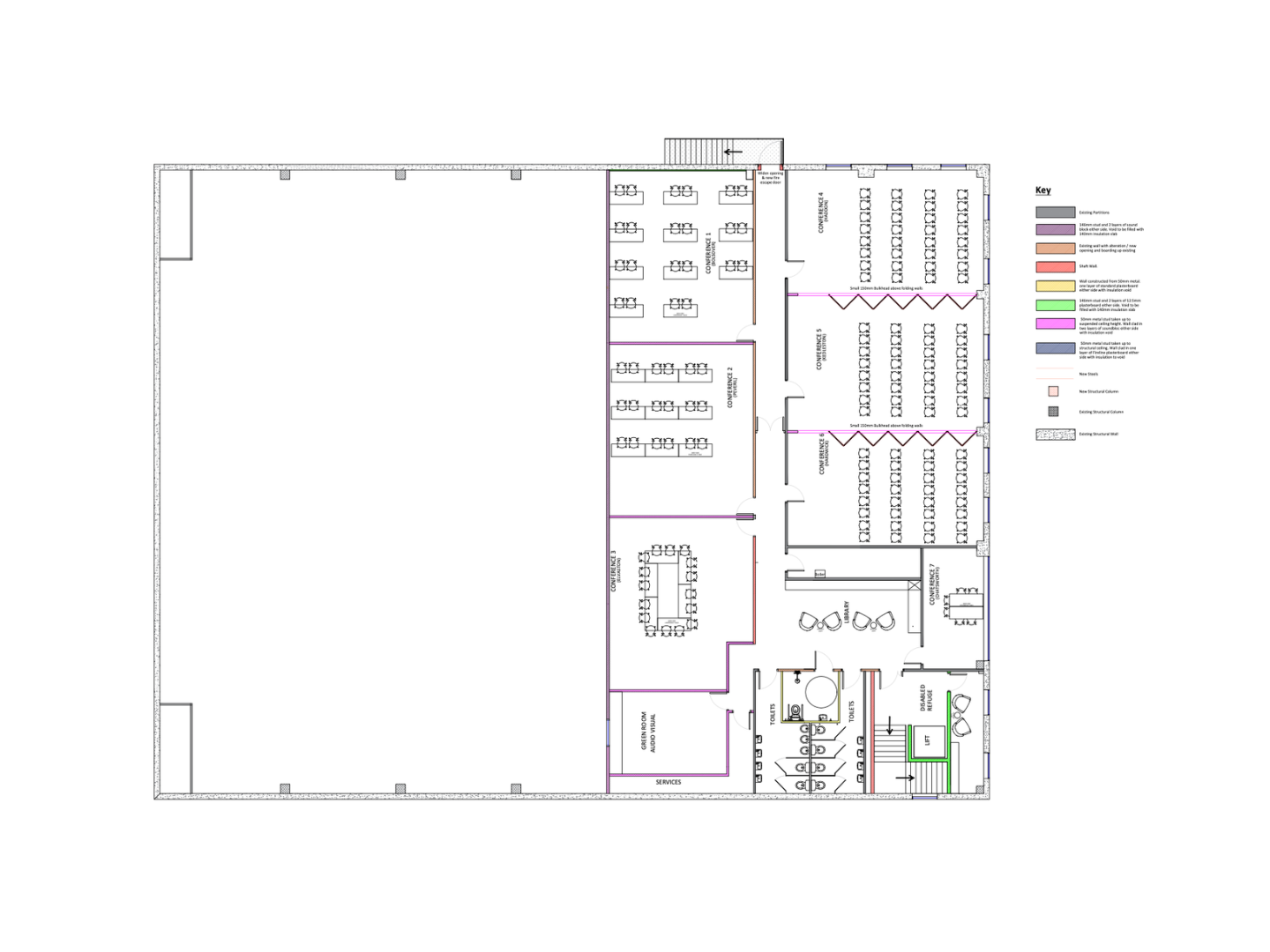
Your partner should bring this to life with CAD plans, mood boards and 3D visuals so you can see the space before a single wall moves. This is also the stage to think about the building fabric itself. Reconfiguring walls might mean new office partitions or glass office partitions to divide the space, and ceiling work such as suspended ceilings for acoustics and a clean finish.
If your space is being handed back to shell or close to it, you may hear the terms CAT A and CAT B. In short, CAT A is the basic, functional landlord standard, and CAT B is the full, branded, move-in ready fit out tailored to you. Knowing where your space sits tells you how much work is ahead.
Stage 8: Plan compliance and health and safety
This is the least exciting stage and one of the most important. Get it wrong and the consequences are serious, both legally and for the people in your building.
The big one is the Construction (Design and Management) Regulations 2015, usually shortened to CDM 2015. If your project is large enough, for example lasting longer than 30 working days with more than 20 workers on site at once, it becomes notifiable. That means appointing a Principal Designer to manage safety during design and a Principal Contractor to manage it on site. A competent partner handles these appointments and the paperwork for you.
Beyond CDM, your design needs to account for:
- Building regulations, including fire safety and escape routes
- Accessibility and the Equality Act, so the space works for everyone
- Ventilation and indoor air quality
- Risk assessments, particularly if you stay in occupation during the works
You remain responsible for health and safety on your premises even when you appoint professionals, so choose a partner who takes it seriously and can show you their procedures. This is one area where the difference between a contractor with an in-house safety team and one who outsources it really shows.
Stage 9: Furniture, storage and technology
Furniture is the most visible part of your new office and the part your team interacts with all day, so it deserves proper attention rather than a last-minute scramble.
Start by reviewing what you already have. If it is in good condition and fits the new layout, reusing it saves money and waste. For anything new, prioritise comfort and longevity:
- Ergonomic, height-adjustable desks and supportive task chairs
- Furniture that signals what a space is for, such as soft seating for informal chats or tall tables for quick standing meetings
- Booths and pods for focus and calls
- Pieces that can be reconfigured as your needs change
Work out your storage needs honestly while you are at it, covering personal storage, team storage, secure storage for sensitive documents, and any off-site archiving.
Technology is the other half of this stage, and it is the part that ruins move-in day if it is left too late. Plan in:
- Data cabling, power, floor boxes and connectivity
- A properly located comms room and server position
- Video-ready meeting rooms with decent screens, cameras and microphones
- Printer and equipment locations
Appoint someone to own IT coordination and testing so that everything actually works on the first morning. For furniture specifically, our office furniture service can help you choose pieces that fit both your layout and your brand.
Stage 10: Build sustainability in from the start
Sustainability is far cheaper to design in than to add later, which is the single most useful thing to understand about it. Specify a low-energy system at the start and it costs little extra. Retrofit it afterwards and the price jumps.
A refurbishment is a natural moment to improve the environmental performance of your space. Practical moves include:
- LED lighting with smart controls such as occupancy sensors and daylight linking
- Efficient HVAC, ideally with the means to monitor energy use
- Recycled-content materials and low-VOC paints for healthier air
- FSC-certified timber and responsibly sourced finishes
- Reusing existing furniture and fittings where you can
- Proper waste segregation and recycling during the works
- Maximising natural light to cut reliance on artificial lighting
If your business reports on ESG, this stage also feeds your wider targets. It is worth discussing certifications and metrics such as your Energy Performance Certificate (EPC), BREEAM, the SKA Rating or NABERS with your partner, so your refurbishment supports the commitments you are already making elsewhere.
Stage 11: Plan the works to minimise disruption
For most businesses, the biggest worry is not the finished office. It is how to keep working while the work happens.
The reassuring news is that you rarely need to fully vacate for a refurbishment. The usual approach is to phase the work, completing one area, floor or zone at a time while the rest of the office carries on. Noisy or disruptive jobs get scheduled for evenings or weekends, and essential services like power and HVAC are shut off at agreed, out-of-hours times.
If you stay in occupation, you may need swing space, a temporary area to move teams into while their part of the building is worked on. Plan this early, keep teams who work closely together near each other, and tell people well in advance where they will be sitting.
There is an honest trade-off here that not everyone mentions. A phased approach keeps disruption down, but it can extend the overall programme and sometimes add cost, because the work is spread out rather than done in one hit. It is worth weighing up which matters more to your business, speed or continuity, and being upfront with your partner about it.
To give you a sense of timings, here is a realistic outline for a small to mid-size office. Larger or more complex projects will run longer, and many of these stages overlap rather than running one after another:
Stage | Typical Duration |
Defining the brief and objectives | 2 to 4 weeks |
Choosing a partner | 2 to 4 weeks |
Designing and space planning | 3 to 6 weeks |
Landlord approvals and License to Alter | 4 to 12 weeks (often runs in parallel) |
Furniture and long-lead items | 4 to 12 weeks lead time |
On-site works | 4 to 12 weeks, depending on size and phasing |
Handover and snagging | 1 to 2 weeks |
The headline point is to start earlier than you think you need to. Long-lead furniture and landlord approvals are the two things most likely to hold you up, and both can be progressed while other stages are still underway.
Stage 12: Manage the handover, snagging and move-in
You are nearly there, and how you handle the final stretch shapes how your team feels about the whole project.
As each area is completed, your partner hands it back to you. Walk it properly and note any snags, the small defects and unfinished details that are normal on any project. A good contractor de-snags as they go rather than leaving everything to the end, which keeps the finish tight and the move smooth. Agree what aftercare looks like too, so you know who to call if something needs attention once you are settled in.
Then there is the move itself, and the human side of it matters as much as the logistics. Keep people informed, offer tours of the almost-finished space, and put on training for any new technology so nobody is fumbling with a meeting room screen on day one.
Finally, mark the occasion. A refurbishment is a genuine milestone for a business. Get some professional photos for your website and socials, and give your team a proper welcome into the space they are going to spend their working days in.
Your printable office refurbishment checklist at a glance
Here is the whole thing condensed into a list you can copy, print or work through. Each line maps to a stage above if you need the detail.
- Define why you are refurbishing and turn it into measurable goals
- Appoint a project champion and pull together your team
- Audit how your current space is really used and gather staff feedback
- Set a realistic budget, including hidden costs and a 10 to 20 percent contingency
- Explore capital allowances, leasing and landlord contributions
- Speak to your landlord and start the Licence to Alter process
- Review your lease, dilapidations and any planning permission needs
- Decide between a single design and build partner or separate appointments
- Shortlist partners and ask the right questions before appointing
- Develop your brief into a space plan and 3D design
- Plan your zones around how your team actually works
- Confirm CDM 2015 responsibilities and compliance obligations
- Check fire safety, accessibility, ventilation and risk assessments
- Review what furniture you can reuse and select what you need
- Plan storage, IT, data cabling and video-ready meeting rooms
- Build in sustainability from the start, not as an afterthought
- Agree a phased programme to keep your business running
- Arrange swing space and out-of-hours works where needed
- Walk each handover, log snags and agree aftercare
- Communicate with staff, train on new tech and celebrate the finish
How ACI can help
If reading all of that has made the project feel bigger, that is exactly why companies bring in a partner who has done it many times before.
At Advanced Commercial Interiors, we have been delivering office refurbishments and fit outs since 2009, for businesses ranging from growing SMEs to names like Harrods, Michael Kors, Mini and Imperial Tobacco. We manage the whole project under one contract, design in-house, work to a fixed price with no surprises at invoice stage, and give you a single project manager who owns the outcome from the first survey to the final handover. We are CHAS and Constructionline accredited, our fitters are CSCS carded, and we are well practised at delivering work in occupied buildings with minimal disruption.
We also do not charge for design. If you would like real numbers against your project, or just want to talk it through, get a free quote and we will take it from there.
Planning an Office Refurbishment? Let’s Talk
A checklist gets you organised, but a good partner gets it built. If you would like to turn this list into a real plan, the ACI team is here to help. We will survey your space, talk through your ideas, and give you a clear, fixed-price quote with no charge for design and no surprises later. Whether you are ready to start or just weighing up your options, we would be glad to hear from you.
Frequently asked questions
How long does an office refurbishment take?
It depends on the size and scope, but for a small to mid-size office you are typically looking at a few weeks of on-site work, with several weeks of planning, design and approvals beforehand. A cosmetic refresh can be done quickly, while a full strip-out and refit takes considerably longer. The two things most likely to extend a timeline are long-lead furniture and landlord approvals, so start both early.
How much does an office refurbishment cost in the UK?
As a rough 2026 guide, a cosmetic refresh tends to start around £25 to £45 per square foot, a mid-level refurbishment runs around £45 to £75, and a full high-specification strip-out and refit can be £75 to £120 or more. These are indicative figures. The only way to know your real cost is a detailed, itemised quote based on your space and your brief.
Do I need to move out during an office refurbishment?
Usually not. Most refurbishments are delivered in phases, with the work completed one area at a time while the rest of the office keeps running. Disruptive jobs are scheduled out of hours. You may need temporary swing space for teams whose area is being worked on, but a full move-out is rarely necessary.
Do I need planning permission for an office refurbishment?
Often not for internal cosmetic work, but structural changes and some alterations can require planning permission or need to meet specific building regulations. If you lease your space you will also need a Licence to Alter from your landlord. A good refurbishment partner will help you identify and handle what applies to your project.
What is the difference between an office refurbishment and a fit out?
A refurbishment updates and improves a space that already exists, working within the structure that is there. A fit out turns an empty, shell or unfinished space into a usable office from scratch. There is plenty of overlap, and we cover it properly in our guide to office fit out vs office refurbishment.
What is a Licence to Alter?
A Licence to Alter is a formal legal document from your landlord that sets out the changes you intend to make to a leased property and the terms under which you can make them. You will usually need one in place before any works begin, so it is worth starting the conversation with your landlord early.