If you are trying to work out what an office fit out will cost, you have probably already found the frustrating truth… everyone quotes a different number, most of the good detail sits behind a download form, and almost nobody tells you what a project like yours actually costs.
So let us start with a straight answer. In 2026, a UK office fit out typically costs somewhere between £45 and £125 per square foot all-in, and can climb well beyond that for premium London projects. That range is real, but it hides an enormous amount, which is exactly why a single figure is close to useless when you are trying to budget.
This guide breaks the number down properly. We cover cost per square foot by specification, cost per person, what you are actually paying for, and, crucially, what a fit out costs for real office sizes rather than a theoretical 10,000 square foot floor plate. We also look at how much your region changes the figure, because a rate quoted for central London has very little to do with a project in the Midlands or the North. No download form, no gated PDF, just the full picture on one page.
The short answer: office fit out costs in 2026
Fit out costs are usually quoted per square foot**, and they rise with the specification level. Here are the broad all-in ranges (covering construction, services, furniture and technology) that the current UK market is working to:
Specification | All-In Cost Per Sqft | What It Gets You |
Basic / Standard | £45 to £85 | A clean, functional space. Sensible finishes, standard furniture, essential M&E. |
Mid-Range | £85 to £135 | A well-designed office with quality ergonimic furniture, better finishes, some feature areas. |
High Spec | £135 to £200 | Bespoke design, premium finishes and joinery, high-end AV, detailed branding throughout |
Premium / Statement | £200+ | No real ceiling. Custom everything, advanced building tech, flagship-quality space. |
Another way to sanity-check a budget is cost per person. As a rough guide, a basic fit out works out at around £500 to £600 per employee, and a good mid-spec fit out with proper ergonomic furniture lands closer to £800 to £900 per person.
Both of these are starting points, not quotes. The only way to know your real cost is to have someone walk your building and price your actual brief. The rest of this guide explains why the number moves so much, and what yours is likely to look like.
CAT A vs CAT B, and why it changes your budget
Before the numbers make sense, you need to know which type of work you are actually paying for. The industry describes how finished a space is using a classification system, and where your project starts has a big effect on cost.
- Shell and core: The most basic state. Structure, facade and shared areas are done, but the floors are empty. No internal fit out at all.
- Cat A: A basic, functional landlord standard. Raised floors, suspended ceilings, basic mechanical and electrical services and some surface finishes. Usable, but blank. No partitions, no furniture, nothing personalised.
- Cat A+: A step up from Cat A, where the landlord adds furniture, some partitioning and breakout areas so a tenant can move in quickly. Common in co-working and short-lease spaces.
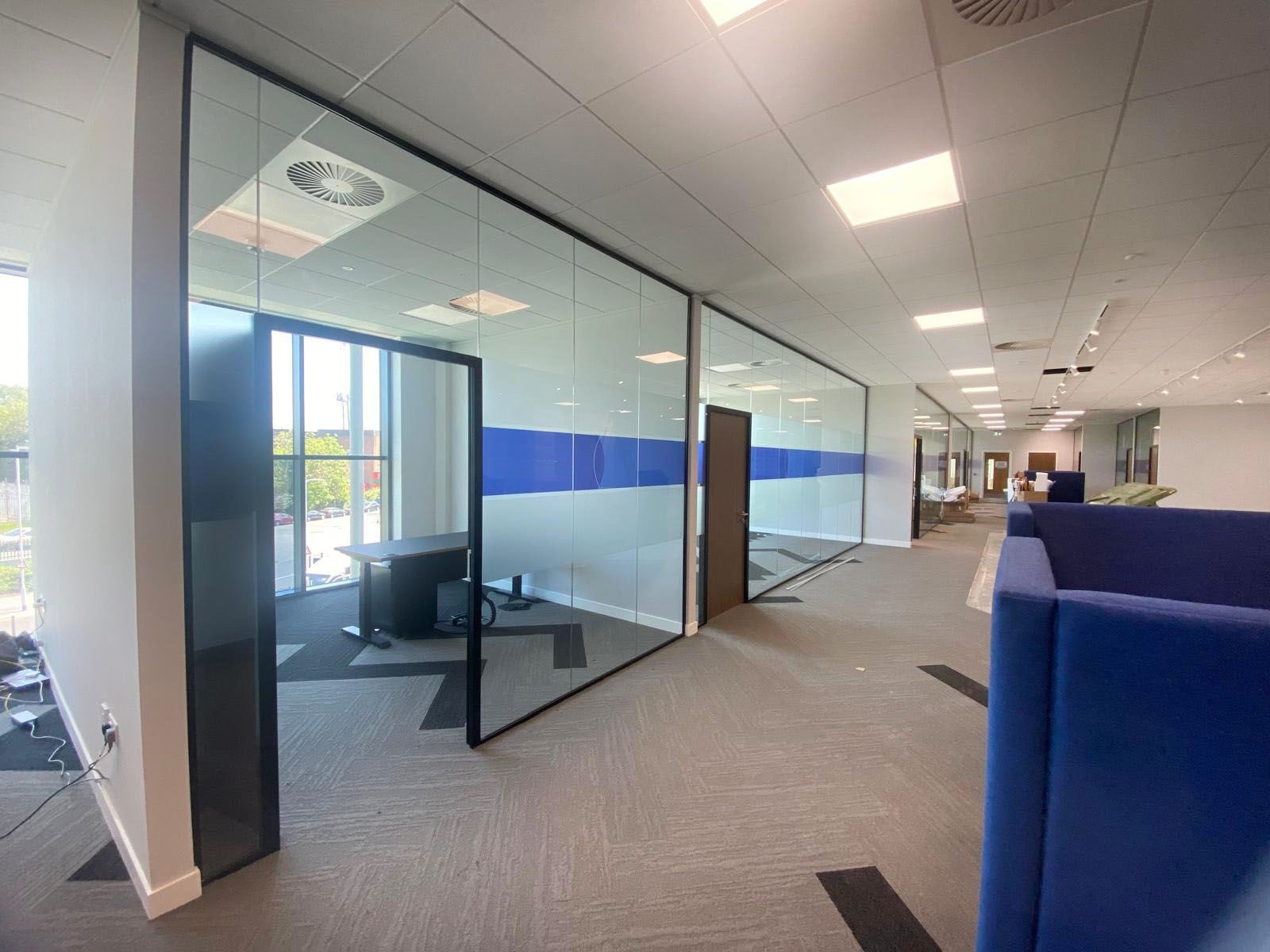
- Cat B: The full, branded, move-in ready fit out tailored to you. Meeting rooms, kitchen, partitions, furniture, branding and the detailed services to suit your layout. This is what most businesses mean when they say they are “having a fit out.”
The key point for budgeting is simple. CAT A is often the landlord’s responsibility as part of your lease. CAT B is almost always yours, and it is where the bulk of your spend will sit. If you are taking on a CAT A space and turning it into your office, a CAT B fit out is the cost you are really planning for. We explain the two levels in more detail on our CAT A and CAT B fit out pages.
Office fit out costs per square foot, by specification
The per square foot figure is driven mostly by how high you specify the space. Here is what tends to sit inside each level:
- Basic or standard: New flooring, decoration, carpet tiles, standard partitions, standard lighting and core mechanical and electrical work. A comfortable, practical office without the extras. Broadly £45 to £85 per sq ft all-in.
- Mid-range: Branded reception, a mix of work settings, upgraded lighting, better acoustics, quality furniture and some structural change. This is where most businesses land. Broadly £85 to £135 per sq ft all-in.
- High spec: Sophisticated design, premium finishes and bespoke joinery, integrated AV, feature lighting and detailed branding. Common for headquarters and client-facing spaces, and for sectors like law, finance and tech. Broadly £135 to £200 per sq ft all-in.
- Premium or statement: Custom-built elements, advanced environmental controls, top-end furniture and fully integrated technology. Costs here do not really have a ceiling.
What you are actually paying for
An office fit out is not one cost, it is a stack of them. Understanding the split helps you read a quote and spot where a number looks off. As a rough guide to how a typical budget divides up:
- Construction and M&E: Mechanical and electrical work alone (heating, ventilation, air conditioning, electrical distribution, data cabling, fire systems and lighting) routinely accounts for 35 to 45 per cent of the total. Add partitions, ceilings and flooring and construction dominates the budget. If a quote looks cheap, this is usually where corners have been cut, and it causes problems for years.
- Furniture and FF&E: Around 15 to 25 per cent. Desks, chairs, storage, breakout and meeting room furniture. The range is huge, from budget task chairs to ergonomic models several times the price.
- AV and IT: Around 5 to 15 per cent. Cabling, connectivity, video-ready meeting rooms, screens and room booking systems. This is the budget most often underestimated, and it is the one that ruins move-in day when it is left too late.
On top of those build costs, you also need to take into account professional and project management fees, and a contingency. We cover these in more detail further along the article.
Worked examples: what a fit out costs for a real office
This is the part most cost guides skip. A per square foot rate is only useful once you turn it into a total for a space the size of yours. Using the market ranges above, here is roughly what different office sizes work out to all-in. Treat these as illustrative ranges based on published 2026 rates, not quotes.
Office Size | Basic Spec | Mid Spec | High Spec |
2,500 sq ft (Small) | £110,000 to £210,000 | £210,000 to £340,000 | £340,000 to £500,000 |
5,000 sq feet (Mid-Size) | £225,000 to £425,000 | £425,000 to £675,000 | £675,000 to £1m |
10,000 sq ft (Larger) | £450,000 to £800,000 | £850,000 to £1.35m | £1.35m to £2m |
One thing worth knowing if you run a smaller office: the headline per square foot rates you see quoted are usually based on large floor plates of 10,000 square feet and above. Below that, the figure tends to creep up. Fixed costs, minimum charges and the simple fact that a small kitchen or a single meeting room costs roughly the same whether it serves 15 people or 50 all push the per square foot rate higher. If your office is 1,500 to 4,000 square feet, budget towards the upper end of each range rather than the middle.
Regional cost differences
Most cost guides quote for London, or for a UK “average” that does not really exist. If your office is in the Midlands, the North or anywhere outside the capital, that matters, because location is one of the biggest swings in the whole budget.
As a general rule, London projects carry a premium of roughly 15 to 30 per cent over the rest of the UK, driven by higher labour rates, access and logistics, and demand. Regional cities such as Manchester and Birmingham often come in 20 to 25 per cent lower than London for comparable work. Published city benchmarks for 2026 illustrate the spread clearly:
City | Low | Medium | High |
London | £148 | £243 | £359 |
Manchester | £128 | £210 | £310 |
Birmingham | £121 | £200 | £295 |
Glasgow | £117 | £192 | £284 |
Figures are per square foot, all-in. Source: Cushman & Wakefield UK Office Fit Out Cost Guide 2026.
The practical takeaway is to budget with numbers that match your location. Pricing a Nottingham or Derby office against a central London rate will either scare you off a project that is more affordable than you think, or leave you comparing quotes against the wrong benchmark. As a Midlands-based fit out contractor working across the region and nationally, this is a gap we see catch businesses out constantly.
What drives your cost up or down
Two offices of the same size can come in at very different prices. These are the factors that move the number:
- Building age and condition: A modern shell with good services is far cheaper to fit out than a tired older building. Asbestos, outdated wiring and poor structural condition all add cost and time.
- The state of the M&E: If the heating, ventilation and power are old or not working properly, replacing them is expensive. This is worth checking before you sign a lease, not after.
- Raised floors: If the space does not have raised access flooring for cabling and services, fitting it or working around it adds cost.
- Specification: The single biggest lever you control. High-end finishes, bespoke joinery and premium furniture add up fast.
- Size and layout: More enclosed spaces, meeting rooms and partitions mean more M&E and more cost per square foot.
- Location and access: City-centre sites may need out-of-hours delivery, parking permits and higher labour rates.
- Timeline: A compressed programme usually costs more, because it means out-of-hours and weekend work.
- Listed buildings: Additional paperwork and restrictions add both time and cost.
- Sustainability choices: Higher-performance systems and materials cost more upfront, though they often pay back through lower running costs.
The costs people forget to budget for
The headline build cost is only part of the picture. The costs that catch businesses out are the ones around the edges, so build these into your budget from the start:
- Professional and project management fees: Design, M&E consultancy and project management typically add 10 to 15 per cent on top of construction costs. These are not optional extras. Good design and coordination save money over the life of the project.
- Contingency: Set aside 10 to 20 per cent of the build cost. Live buildings reveal surprises behind the walls, and a contingency is what stops a surprise becoming a crisis.
- Dilapidations: If you are leaving a space, your lease may require you to return it to its original condition. Reinstatement costs can be significant, often in the region of £15 to £20 per square foot.
- Furniture delivery and installation: Easy to forget alongside the furniture itself, along with removing and disposing of the old.
- Temporary or swing space: If your team cannot stay put during the works, factor in the cost of temporary space or moving in phases.
- Out-of-hours working and security: Disruptive or noisy work scheduled outside office hours can carry a premium.
- Business disruption: Lost productivity during the works is a real cost, even if it never appears on an invoice.
Design and build vs traditional procurement
How you buy the project affects what it costs. There are two broad routes:
- Traditional procurement: You appoint a designer, a contractor and a project manager separately. This can work, but it leaves you managing the gaps between different companies, and when something falls between them, the cost and delay land on you.
- Design and build: One partner handles design, specification, project management and construction under a single contract. Industry research suggests the large majority of fit out projects under £1m are delivered this way, and for good reason. One team is accountable for the whole outcome, decisions are faster, and you get far better cost certainty.
At ACI, we work on a single-contract, design and build basis, with one project manager who owns the outcome from the first survey to final handover. It removes the gaps, and it is a big part of how we keep projects on budget. You can see how that works on our Our Process page.
Sustainability and cost
A fit out is a natural moment to improve the environmental performance of your space, and it is far cheaper to design efficiency in than to retrofit it later. Practical measures include LED lighting with smart controls, efficient HVAC, low-VOC paints, FSC-certified timber and reusing existing furniture where it makes sense.
These choices can add 5 to 10 per cent to material costs upfront, but energy-efficient systems typically pay for themselves within a few years through lower running costs. It is also worth speaking to an accountant about capital allowances, since you may be able to claim on qualifying spend such as lighting, power and data cabling. If your business reports on ESG, certifications and metrics like BREEAM, the SKA Rating and your EPC are worth discussing with your fit out partner early.
How to keep fit out costs down without cutting corners
Reducing cost is not about buying the cheapest of everything. It is about spending in the right places. A few practical ways to protect your budget:
- Get a site survey early. Spotting problems with the building before you sign a lease can save serious money, and can give you leverage to negotiate with the landlord.
- Reuse what works. If your existing furniture is in good condition and fits the new layout, keeping it saves both money and waste.
- Write a clear brief. Vague scopes lead to change orders, and changes mid-project are where budgets slip.
- Value engineer sensibly. An experienced contractor can suggest finishes and systems that deliver the same effect for less.
- Consider phasing. Spreading the work can help cash flow, though be aware it can extend the overall programme.
- Get a fixed price. A properly scoped fixed-price quote protects you from surprises at invoice stage.
- Do not choose on price alone. The cheapest quote is rarely the best value. An underpriced job usually means cut corners, a stream of variations, or a project that runs late.
How to get an accurate quote
A meaningful quote needs meaningful information. At a minimum, a contractor will want to know the size of the space, its current condition, the type of fit out required and the level of specification you are aiming for. A layout plan or drawings help, and if you do not have them, a good contractor will survey the space and develop a brief with you.
Be wary of a single lump sum with no detail. A transparent, itemised quote tells you what is included and, just as importantly, what is not. Provisional sums and vague allowances can hide real costs that surface later. Ask what is excluded, and treat a suspiciously low number as a warning rather than a win.
This is also where the way a contractor prices matters. Some charge for design and quote loosely, then adjust as they go. We do the opposite. ACI provides fixed-price quotations, and we do not charge for design. The figure you agree is the figure you work to.
How ACI approaches fit out costs
We have been delivering office fit outs and office refurbishments since 2009, for businesses ranging from growing SMEs to names like Harrods, Michael Kors, Mini and Imperial Tobacco. Our approach is built around cost certainty:
- Fixed-price quotations, so the figure you agree is the figure you pay
- No charge for design, including CAD plans and 3D visuals before any work begins
- One contract and one project manager, accountable from survey to handover
- CHAS and Constructionline accredited, with CSCS-carded fitters
- Well practised at working in occupied buildings with minimal disruption
We are based in the Midlands and deliver projects across Nottingham, Derby, Leicester, Birmingham, Manchester, London and beyond, which means you get realistic regional pricing rather than a London rate applied to a regional job.
Looking to Improve Your Space?
We have the knowledge and the know-how to take your space from an idea to a reality!
Whether you want a smaller-level refurbishment for an existing space, or you’re wanting a full fit out of a new building, we can help!
Frequently asked questions
How much does an office fit out cost in the UK in 2026?
Most UK office fit outs cost between £45 and £125 per square foot all-in, with premium and central London projects rising higher. Where you land depends on your specification, the condition of the building, your location and the size of the space.
How much does an office fit out cost per square foot?
As a rough guide for 2026: basic fit outs run around £45 to £85 per square foot, mid-range around £85 to £135, and high spec around £135 to £200 or more. These are all-in figures covering construction, services, furniture and technology.
How much does an office fit out cost per person?
A basic fit out works out at roughly £500 to £600 per employee, and a good mid-spec fit out with quality ergonomic furniture is closer to £800 to £900 per person. It is a useful way to sense-check a budget alongside the per square foot figure.
Is a Cat B fit out more expensive than Cat A?
For a tenant, yes, in effect. Cat A is the basic landlord standard and is often covered as part of your lease. Cat B is the full, tailored fit out that turns that blank space into your office, and it is where the bulk of your spend sits.
How much contingency should I allow?
Between 10 and 20 per cent of the build cost, depending on the age and complexity of the building. Older buildings and live projects carry more risk of surprises, so lean towards the higher end.
Are London fit out costs higher than the rest of the UK?
Yes. London typically carries a premium of around 15 to 30 per cent over regional cities such as Manchester and Birmingham, driven by labour, access and demand. Budget with figures that match your actual location.
How long does an office fit out take?
On-site works for a 10,000 square foot office typically run around 10 to 12 weeks, with a smaller office of 2,000 to 3,000 square feet taking closer to 6 to 8 weeks. Add several weeks beforehand for design, procurement and approvals.
What is the most expensive part of an office fit out?
Mechanical and electrical work, usually. M&E (heating, ventilation, air conditioning, power, data and fire systems) routinely accounts for 35 to 45 per cent of the total cost, which is why the condition of a building’s existing services has such a big effect on your budget.
Ready to put a real number against your project?
A cost guide gives you a starting point, but only a proper survey gives you a figure you can plan around. If you would like a clear, fixed-price quote with no charge for design and no surprises later, the ACI team would be glad to help. Whether you are ready to start or still building your business case, we will visit your space, talk through your ideas, and give you an honest number to work with.